Tails From the Barn Blog
Hi Everyone,
In the middle of another stretch of hot, hot days, I find myself eager to share an experience I had recently, one that has almost made me forget about the dizzying heat, the sweat, the flies–all the “perks” of summer.
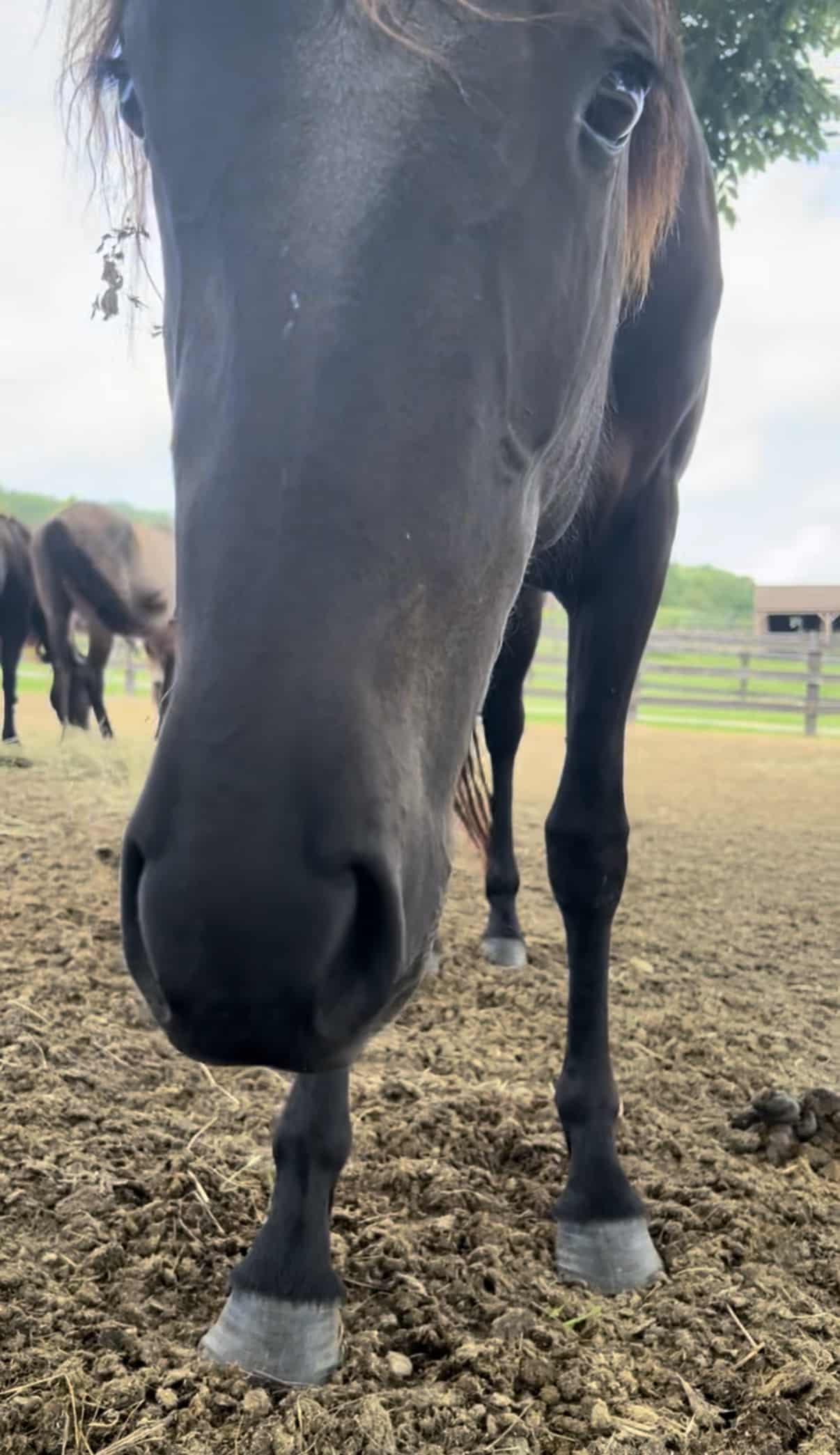
There’s a combined herd of young draft crosses and young free-roaming tribal horses who were born and weaned on tribal lands. (While these horses are often referred to as mustangs, they are not the same mustangs who are managed by the Bureau of Land Management’s Wild Horse Program.) The two groups share an enormous field on the quieter side of the property. Both groups are estimated to be between one and three years old. For the most part, they are unhandled.
Some free-roaming tribal horses hold cultural and spiritual value, and they live out their lives freely on land owned by sovereign tribal nations. However, some free-roaming herds face the realities that some tribal nations face–the desperate scarcity of resources (vegetation and water) and the urgent need for money. These herds might be rounded up, put up for auction or direct sale, even slaughtered. 13 Hands rescued this group before they could suffer a dire fate. A few of the mares, babies themselves, came to us pregnant and have since foaled. With love and attention, the mamas and their foals are thriving. The rest of the horses in this group are thriving, too. However, with the exception of routine medical care and daily hay and water, they are living their lives as a wild herd. None are trained, and none are comfortable with humans approaching.
Entering their paddock was an experiment. Walking alongside Angela (who, by the way, has taken the most stunning photographs of these two groups), I had so many questions. Would they acknowledge me if I sat near them? Would they look my way if I spoke to them? Would they cringe like my family does if I started singing?
Horses can be curious, but I’ve learned that the conditions have to be just right for them to indulge their curiosity. This takes time. In fact, it took more than thirty minutes for the most curious of the combined herd to fully assess our presence. For a good half-hour, they nonchalantly grazed thirty or forty yards away from us as we sat on a rock, chatting. They only glanced in our direction as they pulled hay from the pile. Occasionally, some trotted past us on their way to the water trough, side-eyeing us without acknowledgment.
We sat. We talked and admired their colors, their expressions, their stature. We greeted them in low tones. We did everything we could to project a gentle, loving energy. Then we sat some more. And more after that.
When Angela got up to hang out by the fence, she caught the attention of one of the draft crosses. He walked toward her, listened to her encouragement, and stayed with her for a few minutes, grazing in her steady presence. Magical.
Hoping to bridge the distance between the tribal horses and me, I remained still, trying so hard to hide my impatience.
My legs, a little tired of being in one position for so long, signaled to me that it was time to offer them some circulation. I said out loud, pretty much to no one (but maybe hoping the horses would hear), “I’m going to stand up now. You don’t have to move.” I half-expected the horses to bolt, but it was a funny thing. They didn’t.
Turning my body sideways, I took a few steps toward the herd. Another funny thing. No one moved.
Don’t get me wrong. I wasn’t close. But I was closer.
Then I saw it. Two of them pointed their ears and noses in my direction, allowing their curiosity to guide them. I wanted to celebrate this small gesture; my deliberate movements, my patience (which I often lack), and maybe even my singing had conveyed the unlikelihood of threat.
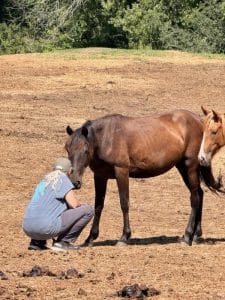
One, a dark bay with soft, eager eyes, led the other, a dark palomino, directly to a space about ten feet in front of me. My elevated heart rate made it hard to stay composed; I wanted so much to reach out. Instead, I made the decision to make myself smaller.
I crouched down, and avoiding eye contact, I watched their hooves take tentative steps toward me. The bay came close enough to sniff my hat; the palomino lingered only a few feet behind. There we stayed, breathing in this first connection, while I prayed my knees wouldn’t buckle. There we stayed, while four other horses joined us. Then, five more. It turns out, in a herd, curiosity can be contagious.
At the very least, we know these young horses have endured trauma; they were rounded up, separated from their family members, herded into pens, and shipped from their home. It is only through a series of terrifying experiences that they are lucky enough to have found sanctuary at 13 Hands. Surely, all of that would be enough to rob me of my curiosity, but horses are remarkable. Smart. Generous. Forgiving. And when we create the right circumstances, curious.
Thank you, Angela, for this experience, and for the photographs I’ve looked at every day since you took them.
With wonder and gratitude and my own curiosity, I’ll be back to visit that combined herd tomorrow, and again and again, for as long as I can.
Karen